
Fresh Produce Export Packaging: Carton, Mesh, Bin, or Punnet?
Packaging is rarely the headline topic in an export discussion, but it directly determines how much product survives transit, how cleanly it presents on the retail shelf, and how cost-efficient the freight is per kilo. Picking the wrong format is one of the most common — and most avoidable — sources of buyer claims.
Telescopic Carton
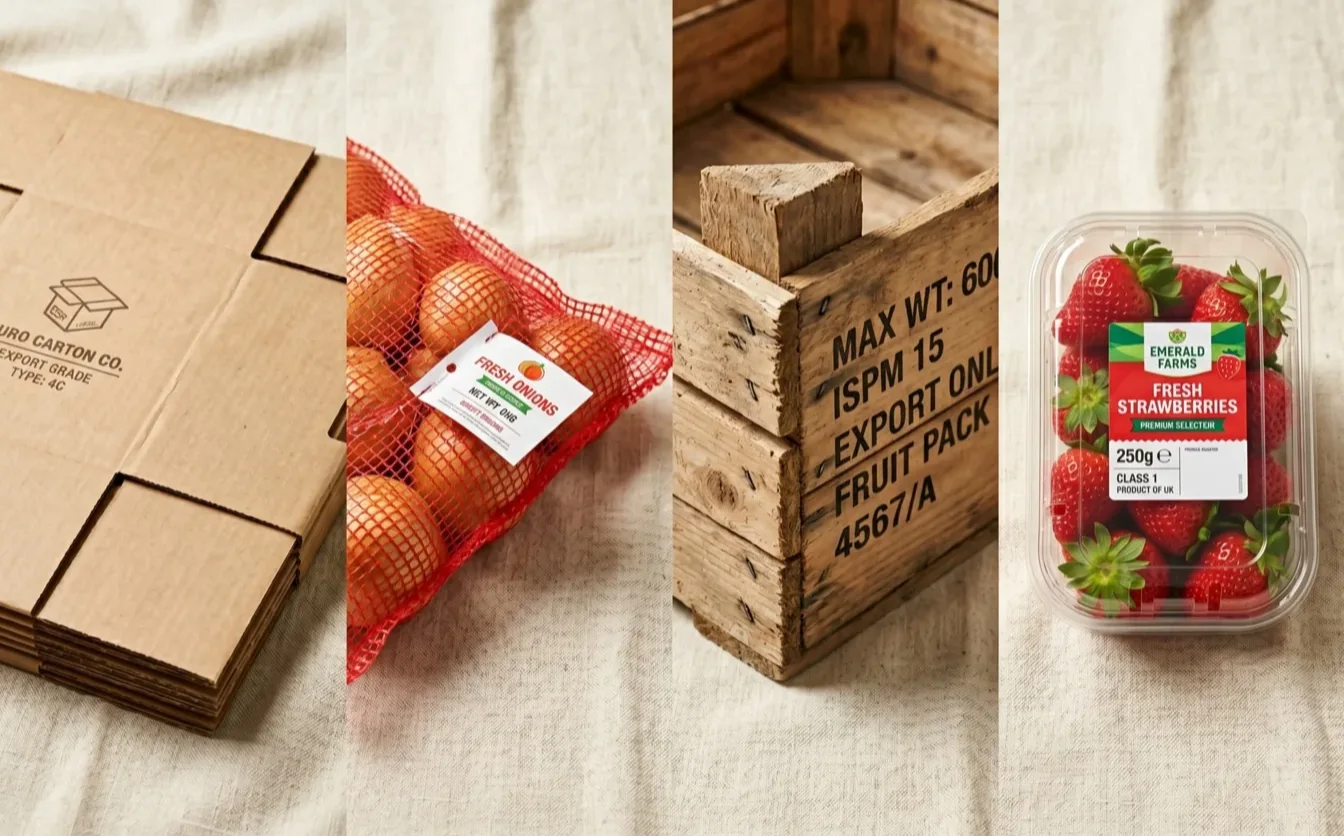
The default for export citrus, mangoes, pomegranates, and most premium fruit. A telescopic carton has a separate base and lid that slide together, providing structural strength when stacked four to seven layers high on a pallet.
Standard formats: 7.5 kg (open tray) and 15 kg (telescopic). The 7.5 kg open tray is sized for retail by-count programs (oranges count 48, lemons count 64). The 15 kg telescopic ships in by-caliber programs and goes through wholesale and food-service channels.
Cost per kilo is the highest of any export packaging — typically €0.05–0.08 per kilo of product — but cartons take printing well, which makes them the only realistic option for retailer private-label programs.
Open Tray
A shallower variant of the telescopic format. Better ventilation, slightly cheaper, less stack strength. Used heavily for grapes, strawberries, and citrus moving by air freight. The shallower depth limits crush damage on softer products.
Mesh Bag
The workhorse for onions, garlic, and potatoes. A 25 kg red or yellow mesh bag costs less than a tenth of a comparable carton and ventilates the product through transit, which is essential for cured alliums.
Limitations: mesh prints poorly, so retail private-label programs avoid it for anything other than basic logo bands. Mesh is also flammable, which matters for some destination ports.
For potatoes specifically, EU retail programs increasingly use 2 kg or 2.5 kg consumer mesh bags inside a master carton, combining the ventilation benefits of mesh with the printing surface of a carton.
Wooden Bin
The 600 kg open wooden bin (sometimes called a wooden crate or palox) is the standard for bulk inter-warehouse logistics. Used for citrus and apples destined for repacking at the importer's facility.
Bins do not present at retail. They are a wholesale and processing format. Per-kilo cost is the lowest of all formats listed here, often under €0.02 per kilo of product. Heat treatment and ISPM-15 stamping are required for export — confirm your bin supplier complies.
Plastic Clamshell or Punnet
The retail-ready format for berries, table grapes, and cherry tomatoes. Standard sizes: 250 g, 500 g, 1 kg. Most clamshells are PET, increasingly with recycled content to meet EU Packaging and Packaging Waste Regulation (PPWR) targets.
Punnets ship inside corrugated master cases, usually 8–12 punnets per case. The whole assembly is the unit of cost calculation.
Sustainability Pressure From EU Buyers
The EU's Packaging and Packaging Waste Regulation (Regulation 2025/40, in force from August 2026) introduces minimum recycled content for plastic packaging and a path toward all packaging being recyclable by 2030. Retail buyers in the Netherlands, Germany, and Sweden are pushing supplier specs ahead of the regulatory deadline.
What this means for an Egyptian exporter: be ready to specify recycled content percentages on plastic punnets and to switch to FSC-certified corrugated cartons. Buyers increasingly ask for this in writing as part of the supplier qualification.
Picking the Format
Start with the destination program. Retail private label drives you toward telescopic carton or punnet-in-master. Wholesale and food service open up bins and bulk mesh. Mode of transport adds another constraint: air freight rewards lighter, shallower formats, while sea reefer can take the heavier formats.
Finally, never specify packaging in isolation from the buyer's specification. The cheapest format that meets the spec is always cheaper than the more expensive one that does not.
Interested in sourcing Egyptian produce for your program?
Related articles
EU MRL Compliance for Egyptian Fresh Produce: A Practical Guide
Egyptian shipments rejected at EU ports almost always trace back to one of three pesticide residues. Here's what to test for, why border rejections happen, and how to keep retail programs alive.
Read article →
Sourcing Egyptian Potatoes for European Retail Programs
Egypt produces over six million tonnes of potatoes a year. Not all of it is retail-ready. Here's what buyers sourcing for EU supermarkets need to know about varieties, sizing, and timing.
Read article →