
Egyptian Mango Season: What Buyers Should Know Before Placing Orders
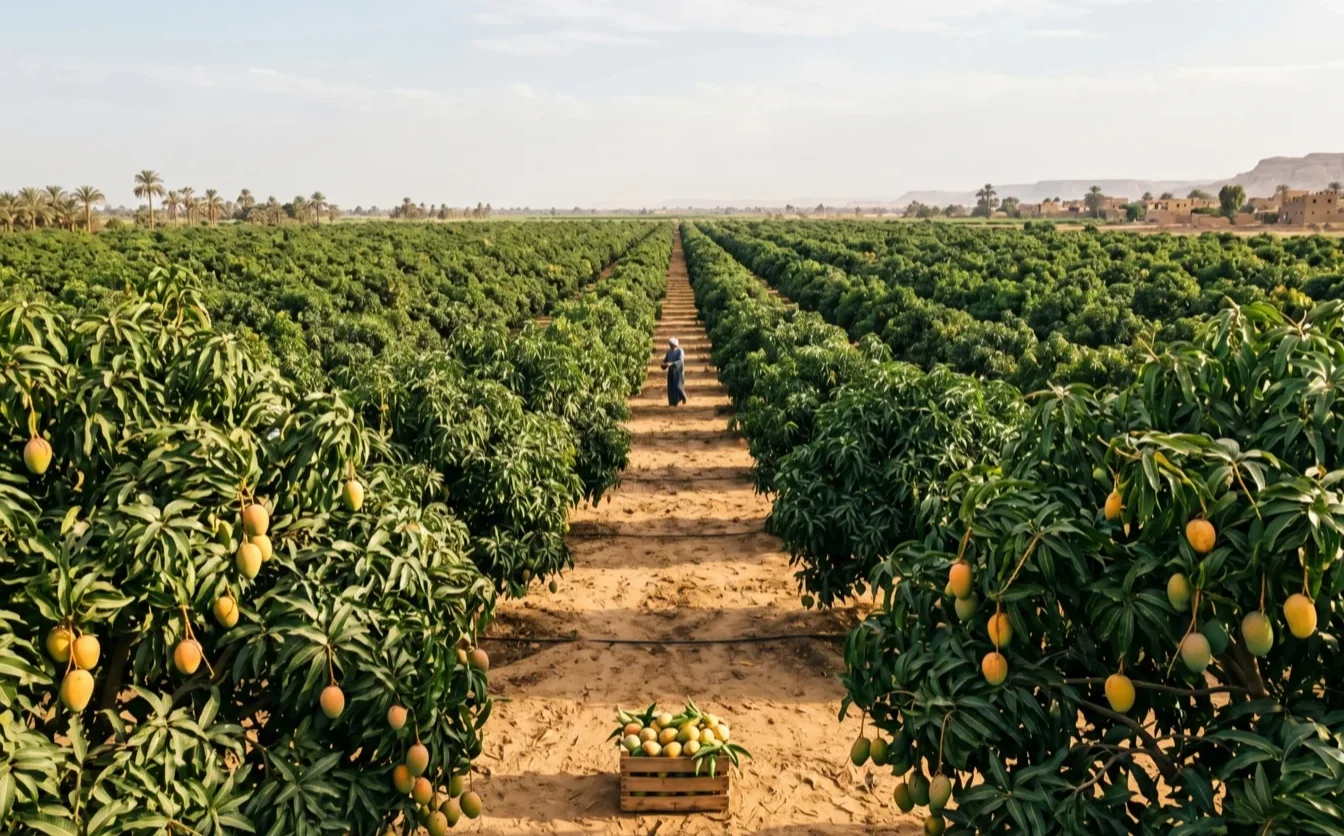
Egypt is not the first country buyers think of when sourcing mangoes, but it should probably feature more prominently in summer programs. The main season runs June to October, filling the window after the end of Israeli and Peruvian supply and before the arrival of South African volumes.
Key Export Varieties
**Keitt** is the dominant export variety: large, green-skinned when ripe, with excellent flesh-to-seed ratio and low fibre. It holds well in transit and arrives firm at destination — an important characteristic for buyers with slow-moving retail programs.
**Kent** is the second export variety, offering deeper orange-yellow skin colour and a sweeter, more aromatic profile. It tends to perform better in GCC markets where consumers associate skin colour with ripeness.
**Zebda** and **Ewais** are the local Egyptian varieties: sweet, low-fibre, intensely aromatic. Export demand has been growing, particularly in GCC specialty retail and Egyptian diaspora communities in Europe, but volumes are lower and size uniformity varies more than with Keitt or Kent. They are specialty varieties, not programmatic ones.
The Quality Window
Peak quality for Keitt and Kent export falls in July and August. June fruit can be slightly under-mature, and September to October fruit tends toward softer flesh and shorter shelf life. If you are building a retail program, target the July to August window as your core volume and treat the shoulders as supplementary.
Hot Water Treatment
Many markets — including the United States and some GCC countries — require hot water treatment (HWT) for mango imports to control fruit fly. Egypt has approved HWT facilities. Confirm whether your destination market requires it before confirming an order: it adds 2 to 3 days to packing timelines and requires a specific facility.
Cold Chain Considerations
Mangoes must not be stored below 12 to 13 °C or chilling injury occurs. Reefer containers should be set at 12 to 13 °C with appropriate ethylene management for the ripeness stage at loading.
For GCC destinations (Jeddah 7 to 9 days, Dubai 8 to 10 days from Alexandria), both Keitt and Kent typically arrive in good condition with correct cold-chain management. For the longer European route (12 to 16 days), Keitt is the safer choice for retail programs because of its firmer arrival profile.
Interested in sourcing Egyptian produce for your program?
Related articles
EU MRL Compliance for Egyptian Fresh Produce: A Practical Guide
Egyptian shipments rejected at EU ports almost always trace back to one of three pesticide residues. Here's what to test for, why border rejections happen, and how to keep retail programs alive.
Read article →
Sourcing Egyptian Potatoes for European Retail Programs
Egypt produces over six million tonnes of potatoes a year. Not all of it is retail-ready. Here's what buyers sourcing for EU supermarkets need to know about varieties, sizing, and timing.
Read article →